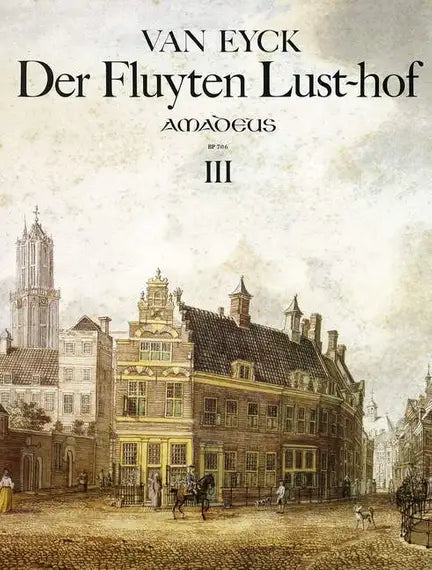
Van Eyck- Der Fluyten Lust-hof for Descant Recorder (or Flute)
Composer: Jacob van Eyck
Editor: Winfried Michel and Hermien Teske
Flute score
Publisher: Amadeus Verlag
About
The series contains variations on folk songs, psalms, dances, and popular tunes for solo recorder/flute by Jacob van Eyck. Many are highly virtuosic and can absolutely be used as technical studies because of the ornamentation, breath control, finger technique, and variation writing, but they were conceived as performance repertoire rather than pedagogical etudes.
The present edition is the first complete edition with full commentary. Text is in both English and German
Contents Vol. 1
- Preludium of Voorspel
- Onse Vader in Hemelryck
- Doen Daphne d’over schoone Maeght
- Psalm 118
- Malle Symen (Malsimmes)
- Psalm 140. ofte tien Geboden
- Aerdight Martyntje
- Pavaen Lachrymae
- Lavignone
- Rosemont
- Courant, of Ach treurt myn bedroefde
- d’Lof-zangh Marie
- Frans Ballet
- Stil, stil een reys
- Fantasia & Echo
- Geswinde Bode van de Min
- Onan of Tanneken
- Psalm 68
- l’Amie Cillae
- Bravade
- Psalm 103
- Van Goosen
- Si vous me voules guerir
- Courante
- Ghy Ridders in het prachtigh Romen
- Ballette Gravesand
- Engels Nachtegaeltje
- Ach Moorderesse
- Lanterlu
- Philis schoone Harderinne
- Vande Lombart
- Comagain
- Courant
- Tweede Daphne
- Amarilli mia Bella
- Lus de mi alma
- Engels Lied
- Philis quam Philander tegen
- Al hebben de Princen haren
- Tweede Rosemond
- De zoete Zoomertyden
Contents Vol. 2
- Wilhelmus van Nassouwe
- Meysje wilt uy slapen
- Courante Mars
- Balette Bronckhorst
- Schoonste Herderinne
- Rosemond die lagh gedoken
- Wat zalmen op den Avond doen
- Courante
- Repicavan
- Janneman en Alemoer
- O Heyligh zaligh Bethlehem
- Tweede Courante Mars
- Tweede Lavignone
- Pavaen Lachryme
- Engels Nachtegaeltje
- Derde, doen ick u d’over
- Amarillen doet myn willeken
- Eerste Carileen
- Tweede Carileen
- Derde Carileen
- Amarilli mia bella
- Courante Madame de la montagne
- O slaep, o zoete slaep
- Gabrielle Maditelle
- Een Spaense Voys
- Een Courante
- Vierde Carileen
- Een Frans Air
- Kits Almande
- Schasamise vous re veille
- Prins Robbert Masco
- Engels Liedt, met 2
- More palatino, met 2
- Amarilli mia bella, met 2
- Prins Robbert Masco, met 2
- Engelse hier koom ick by nacht
- Wel Jan
- Stemme nova (I)
- Stemme nova (II)
- Psalm 150
Contents Vol. 3
- Praeludium
- Phantasia
- Psalm 1
- Silvester inde Morgenstont
- Almande Verryt
- Psalm 9
- La Bergere
- France air
- Princes roayele
- Psalm 33
- Philis en son bel Atente
- Ho ho op myn brack en winden, &c.
- Postillon
- Na dien u Godlyckheyt
- Onder de Linde groene
- Bockxvoetje
- Psalm 119
- En fin l’Amour
- Lossy
- Boffons
- Psalm 133
- De lustelycke Mey
- Excusemoy
- Verdwaelde Koningin
- Malle Symen
- Blydschap van myn vliedt
- Den Nachtegael
- 1. Ballet, of Vluchste Nimphje van de Jagh
- Janneman en Alemoer
- 2. Ballet, of Ay Harder hoort
- Een Kindeken is ons geboren
- 2. Courant, of Harte diefje waerom zoo stil
- Courante 1
- 3. Ballet
- Wel op, wel op, ick gae ter jaght
- 4. Ballet
- Lanterlu
- Psalm 15
- Laura
- Puer nobis nascitur
- Psalm 116
- Questa dolce sirena
- Ballet de Grevelinge
- Almande prime roses
- Lavolette
- De eerste licke-pot
- De tweede licke-pot
- Ick plach wel in den tydt voor desen
- Frans Air
- Orainge
- Sarabande
- Beginnende door reden ons gegeven
- Stemme Nova
- Bockxvoetje
- Fantasia
- Psalm 101
- De France Courant
- Psalm 134
About Jacob van Eyck
Jacob van Eyck (c.1589/90–1657) was a blind Dutch musician, composer, and bell expert who became one of the most important musical figures of the Dutch Golden Age. Born near Heusden into a noble family, he developed exceptional skills in bell tuning, carillon performance, and recorder playing from a young age.
Van Eyck gained recognition as a carillonneur in Utrecht, where he improved and expanded the city’s carillons, especially those of the Dom Tower and several churches. His expertise in bell casting and tuning was highly respected, and he became Director of the Bell Works in 1628. He discovered how to isolate the different overtones (“partials”) of a bell and influenced the famous Hemony bell founders, helping transform Dutch bell tuning standards.
Alongside his technical achievements, van Eyck was admired as a virtuoso recorder player. He often performed outdoors in churchyards and public spaces, entertaining evening crowds. His most famous work, Der Fluyten Lust-hof, is a large collection of solo recorder music and variations that remains one of the most challenging and important recorder publications today.
Van Eyck collaborated with leading intellectuals and musicians of his time, including René Descartes and Constantijn Huygens, who admired his understanding of acoustics and resonance.
He continued working as a carillonneur, inspector, teacher, and performer until illness forced him to reduce his duties in the 1650s. He died in Utrecht on March 26, 1657, and was honoured by hours of bell ringing from the city churches. Known as the “Utrecht Orpheus,” van Eyck left a lasting legacy in both recorder music and the art of bell tuning.