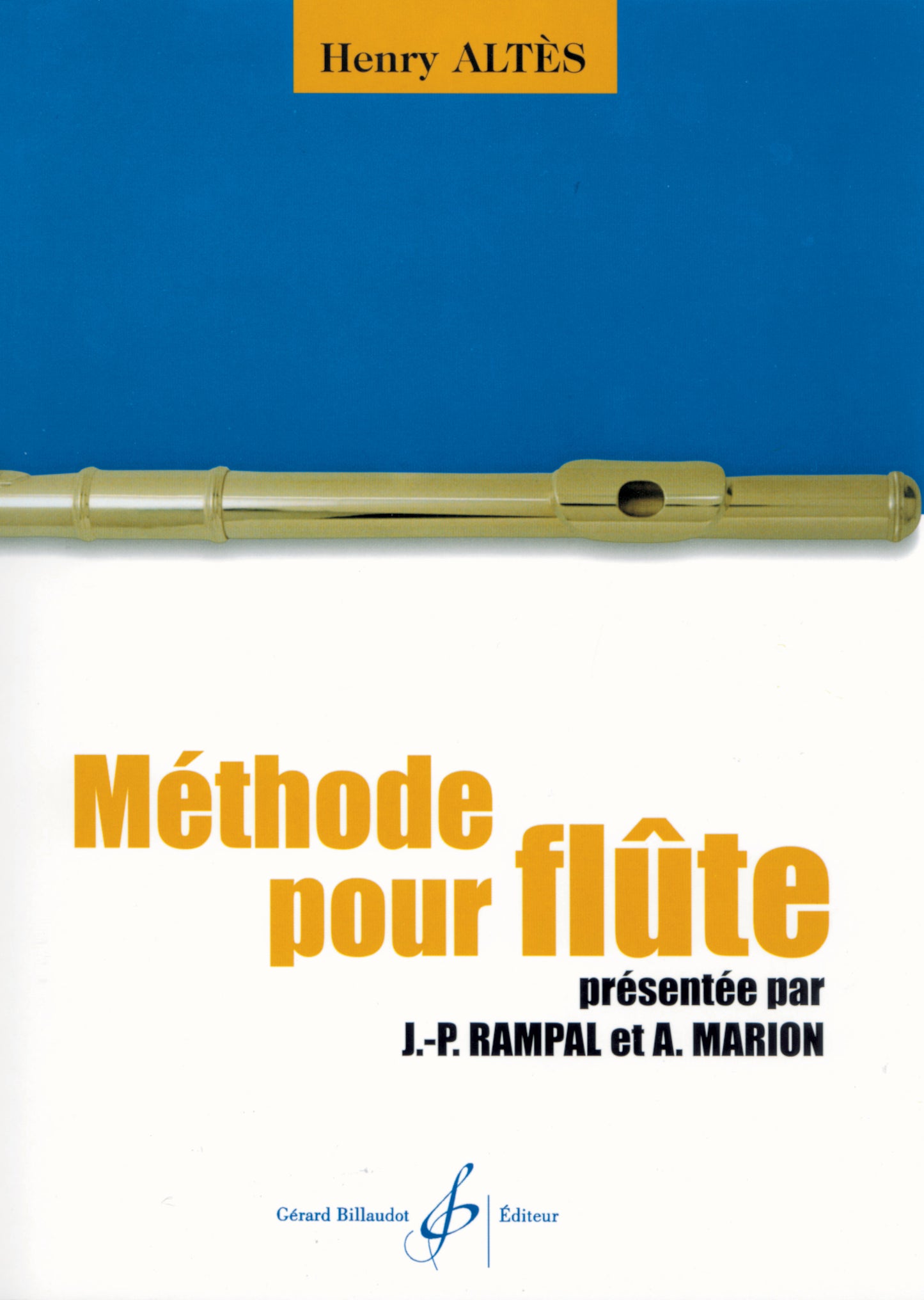
Altès- Method for Flute (Billaudot)
Composer: Henri Altès
Editor: Jean-Pierre Rampal and Alain Marion
Flute score
Publisher: Gérard Billaudot
About
Henry Altès’ Méthode de Flûte is one of the most influential and widely used French flute methods, offering a comprehensive approach to flute playing from beginner foundations to advanced technique. Presented in this Billaudot edition by Jean-Pierre Rampal and Alain Marion, the method combines traditional pedagogy with the insights of two of the great figures of the French flute school.
Covering tone production, articulation, scales, phrasing, ornamentation, finger technique, musical style, and expression, the method progresses through structured lessons and studies designed to build both technical fluency and musical understanding. Rich in exercises, scales, duets, and stylistic material, Altès’ method remains an essential resource for flautists and teachers alike.
Written text is in French.
Contents
- Foreword
- Preliminary Notes
- Diagram and Description of an Assembled Flute
- How to Hold the Flute
- Position of the Flute Player
- Tone Production and its Starting Point
- Lesson 1: 2-time meter, C or 2/2 or 2, whole notes, half notes, whole and half rests, fingering of the C major scale
- Lesson 2: 2-time meter, 2/4, half notes, quarter notes, quarter rests
- Lesson 3: 4-time meter, 4/4 or common time, dotted half notes
- Lesson 4: 3-time meter, 3/4, eighth notes, dotted quarter notes, eighth rests
- Lesson 5: Low notes
- Lesson 6: Equality and accuracy of tone, octaves, 6/8 meter, slurred and detached notes, sixteenth notes
- Lesson 7: 3/8 meter, triplets, syncopation
- Lesson 8: C major scale and arpeggio, scales in thirds, D.C. (Da Capo)
- Lesson 9: Key of G major
- Lesson 10: Key of D major
- Lesson 11: Key of F major
- Lesson 12: Key of B-flat major
- Lesson 13: Key of A major
- Lesson 14: Key of E-flat major, 9/8 meter
- Lesson 15: Study of chromatic scales in C and A
- General Range of the Flute with Standard Fingering
- Table A: Scales and arpeggios in all major sharp keys followed by chromatic scales in A and C; scales and arpeggios in all major flat keys followed by chromatic scales in A and C
- Study of Scales and Arpeggios divided into two alternative series
- Scales and arpeggios in all major and minor keys – Series 1
- Scales and arpeggios in all major and minor keys – Series 2
- Lesson 16: Study of various articulations, louré tonguing, 12/8 meter, keys of E-flat major and A-flat major
- Lesson 17: Study of syncopations, keys of A-flat minor and E-flat minor
- Study of the Leading Note
- Table B: Fingerings giving greater accuracy to certain leading notes while making execution easier
- Lesson 18: Studies to become familiar with the fingerings of leading notes, keys of D minor and G minor
- Lesson 19: How to perform the long or melodic appoggiatura
- Lesson 20: How to perform the short or rhythmic appoggiatura, keys of B minor and major, E-flat major and C-sharp minor
- Table C: Trill Fingerings
- Lesson 21: Study of the trill and compound tonguing
- Lesson 22: Study of the broken cadence
- Lesson 23: Study of the mordent
- Lesson 24: Study of four-note gruppetti
- Lesson 25: Study of three-note gruppetti
- Lesson 26: Study of sustained tones (sons filés)
- Lesson 27: Rests, dynamics and expression, keys of F-sharp minor and major, B major, C-sharp minor and major, 6/4 meter
- Lesson 28: Musical abbreviations, keys of D-flat major and B-flat minor
- Lesson 29: Early music, 3/2 meter
- Lesson 30: Sonata for two concertante flutes, 9/4 meter, key of F minor
About Joseph-Henri Altès
Joseph-Henri Altès (1826-1895)[1] was a French flautist, composer and teacher.
In 1840, he won a place at the Conservatoire de Paris studying with the renowned flautist/composer of the time, Jean-Louis Tulou.
From 1848 to 1872, he was Principal Flute of the Orchestre de l’Opéra National de Paris. In 1868 he was appointed as a flute professor at the Paris Conservatoire teaching students such as Georges Barrère and Adolphe Hennebains.
His ‘Célèbre méthode complète de flûte’ remains a popular method in the flute repertoire. Housed at the Paris Conservatoire are forty of his compositions, including his fantasies on opera themes and six solos used for the annual Concours at the Paris Conservatoire.